:REWORK_RESEARCH [plagiarism and similarities]:
With the reworking of someone else’s copyrighted material I found that there seems to be a fine line to be drawn between similarities between a reworked piece and the original, as if the new work has taken inspiration from the original, and plagiarism, where by the new piece rips off the original. So where do similarities end and when does plagiarism begin?
I found a really nice example of this in relation to fine art photography. It come’s in the from of a discussion created by German photographer Jörg M Colberg of www.jmcolberg.com. Colberg writes a long piece focused on the photography’s by Peter Bialobrzeski and Horst and Daneil Zielske, a father and son team. Now Bialobrzeski took a series of photos in Shanghai to be included in his collection entitled “Neon Tigers”, they featured in his book along with a number of exhibitions he put on around the globe. The Zielske’s photos appear to be of not only the same content including angle, focus and distance from subject but also of same graphic quality.
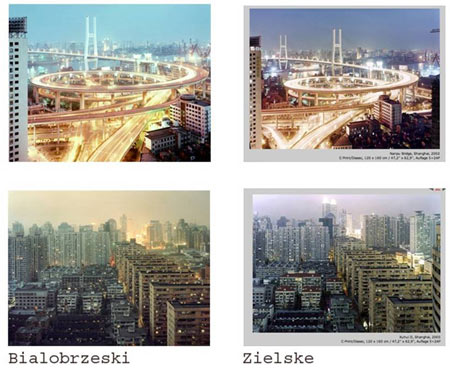
image taken from www.jmcolberg.com
These were on show at Hamburg's Museum für Kunst und Gewerbe (MKG) and appear to have been created for commercial purpose. The Zielske’s certainly knew of Bialobrzeski’s work before they completed their own as they even contacted Bialobrzeski before hand asking for advice between colleagues which he gave. Bialobrzeski seemed happy enough until the work was then published by the Zielske’s and then Bialobrzeski asked for the work to be taken off display.
View the full article by Jörg M Colberg at www.jmcolberg.com
This brought up an interesting idea that plagiarism refers not to the work it’s self but in it’s application, and only become s a problem if it is copied for profit.
A lot of artists publish their work under the one of the ‘Creative Commons Licenses’ which place work within the public domain and can be used by other artists dependant on the terms and conditions of the license, for instance provided it is not used for commercial purpose.
With the reworking of someone else’s copyrighted material I found that there seems to be a fine line to be drawn between similarities between a reworked piece and the original, as if the new work has taken inspiration from the original, and plagiarism, where by the new piece rips off the original. So where do similarities end and when does plagiarism begin?
I found a really nice example of this in relation to fine art photography. It come’s in the from of a discussion created by German photographer Jörg M Colberg of www.jmcolberg.com. Colberg writes a long piece focused on the photography’s by Peter Bialobrzeski and Horst and Daneil Zielske, a father and son team. Now Bialobrzeski took a series of photos in Shanghai to be included in his collection entitled “Neon Tigers”, they featured in his book along with a number of exhibitions he put on around the globe. The Zielske’s photos appear to be of not only the same content including angle, focus and distance from subject but also of same graphic quality.
image taken from www.jmcolberg.com
These were on show at Hamburg's Museum für Kunst und Gewerbe (MKG) and appear to have been created for commercial purpose. The Zielske’s certainly knew of Bialobrzeski’s work before they completed their own as they even contacted Bialobrzeski before hand asking for advice between colleagues which he gave. Bialobrzeski seemed happy enough until the work was then published by the Zielske’s and then Bialobrzeski asked for the work to be taken off display.
View the full article by Jörg M Colberg at www.jmcolberg.com
This brought up an interesting idea that plagiarism refers not to the work it’s self but in it’s application, and only become s a problem if it is copied for profit.
A lot of artists publish their work under the one of the ‘Creative Commons Licenses’ which place work within the public domain and can be used by other artists dependant on the terms and conditions of the license, for instance provided it is not used for commercial purpose.
posted by Greg Pidgeon at 10:02 PM


0 Comments:
Post a Comment
<< Home